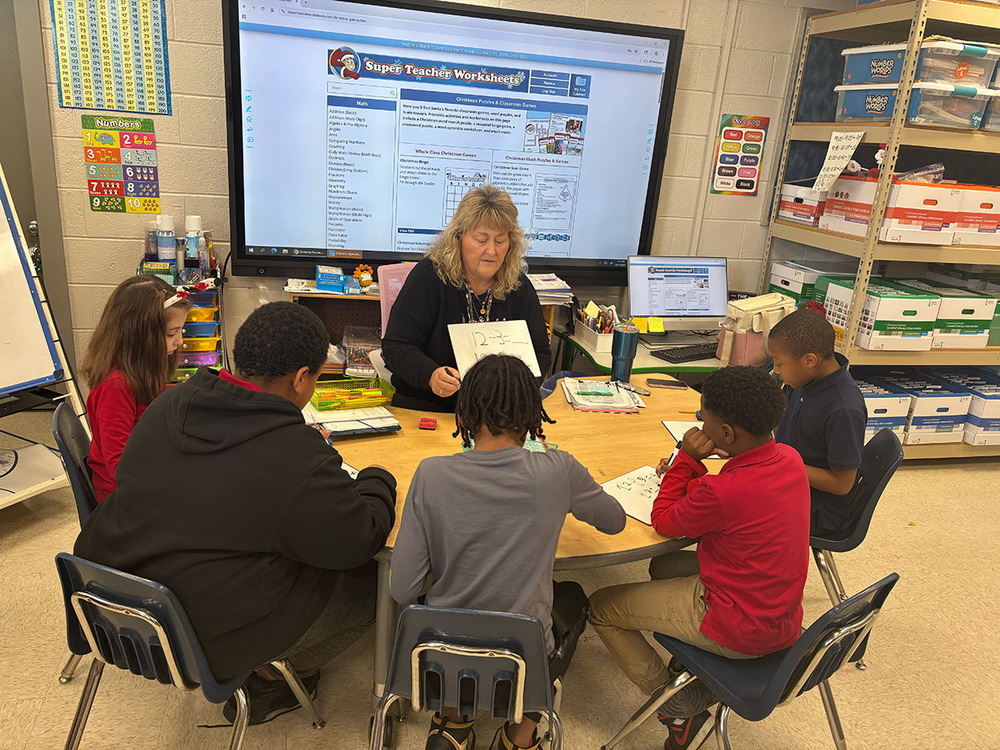
Long after the bell rings and retirement papers are signed, some educators still feel the pull of the classroom. At Hines Primary, that pull has brought retired teachers back; not for full classrooms and lesson plans, but for small tables, dry-erase boards, and moments when a concept finally clicks.
For Sally Williams, Sheri Popken, and Kathy Zeiters, tutoring isn’t a second career. It’s a continuation of who they are.
Sheri returned because she missed teaching—but wanted to do it differently. With a background in both special education and general education, she found her purpose in small groups, where progress feels personal and immediate.
“I still want to teach, but I like the freedom of tutoring. Working with small groups, I really feel like I’m making a difference,” said Sheri.
Sheri spent 35 years in the district before retiring. Sally and Kathy each taught at Hines for 26 years. Best friends since high school, they grew up in Peoria, taught in Peoria, and after retirement found themselves back together, serving Peoria’s students once again.
“When you’re a teacher, it’s in your blood,” said Sally.
Their work happens during Guided Individual Practice (GIP) time, so students aren’t missing core instruction. Instead, they receive targeted support exactly where they need it. The groups are fluid; students move in when they need help and “graduate out” when they’re ready to succeed independently.
The results aren’t just academic. Confidence grows alongside reading fluency and math skills.
Sally recalls a second grader who once struggled both behaviorally and academically.
“She came running up to me and said, ‘I met my goals in reading and math from NWEA.’ Her confidence changed everything, her learning and her behavior,” Sally said.
Another group of fourth-grade boys went from dreading division problems to asking excitedly if they could practice more.
“It’s nothing fancy. We use a whiteboard to solve math problems—but it’s exciting when you finally understand,” said Sheri.
Tutoring fills a critical gap for families who may not have the time or resources for private support. Unlike volunteer-based programs, these students work with trained, experienced educators who collaborate closely with classroom teachers.
“If kids don’t get those foundational skills early, they struggle for a long time. We’re trying to prevent that,” said Sheri.
The tutors know their work depends on funding and support, but they also know its value, to teachers, families, and especially students.
“It takes a village,” Kathy said. “And this is how we’re helping our village.”
They may be retired, but at Hines, their impact is very much present. One small group, one breakthrough, and one confident student at a time.